Here's an album I've been meaning to blog about for some time, Oorutaichi's Drifting My Folklore from 2007. I don't know much about Oorutaichi, other than that he's a Japanese solo artist/DJ who cooks up some seriously zany acid cartoon music. If you thought that was Cornelius's shtick, prepare to experience new levels of zany acidity - Drifting My Folklore comes bursting at the seams with mutated disco, freak funk, twisted pop hooks, synths and turntables galore, hypnotic grooves, and utterly bizarre vocal melodies that shouldn't work but somehow do. Rarely are albums simultaneously as strange and catchy as this one. Given the overwhelming number of different musical ideas that transpire throughout it, one must really admire Oorutaichi's flawless sense of craft in arranging so many instruments and studio effects into something cohesive, without a moment sounding out of place. (Then again, what could sound out of place on an album like this?) The studio tricks in particular are frequently mindbending and worthy of Nobukazu Takemura at his best. In the end there's probably no describing this album, so let's just say I can comfortably imagine alien robots doing their morning workout routine to it, and leave it at that.
Aside, Oorutaichi contributed one of the best tracks on Shugo Tokumaru's 2009 release Rum Hee, a remix of Shugo's song of the same name.
I just found out that 5 days ago was the late Toru Takemitsu's 79th birthday, so here's a belated dedication and celebration post. I bring you quite a large collection of instrumental and choral works by the visionary man Wikipedia documents as Japan's first international composer:
In the late 1950s chance brought Takemitsu international attention: his Requiem for string orchestra (1957 listen (help·info)) was heard by Igor Stravinsky in 1958 during his visit to Japan. (The NHK had organised opportunities for Stravinsky to listen to some of the latest Japanese music; when Takemitsu's work was put on by mistake, Stravinsky insisted on hearing it to the end.) At a press conference later, Stravinsky expressed his admiration for the work, praising its "sincerity" and "passionate" writing.[14] Stravinsky subsequently invited Takemitsu to lunch; and for Takemitsu this was an "unforgettable" experience.[15] After Stravinsky returned to the U.S., Takemitsu soon received a commission for a new work from the Koussevitsky Foundation which, he assumed, had come as a suggestion from Stravinsky to Aaron Copland.[15] For this he composed Dorian Horizon, (1966), which was premièred by the San Francisco Symphony Orchestra, conducted by Copland.
Takemitsu later became a close personal friend of John Cage, who encouraged him to embrace his nation's musical traditions for the first time, leading to a new stylistic period combining ancient Japanese and Western avant garde ideas. At the same time, Toru was also highly conscious of Western popular music, as evidenced by his many guitar transcriptions of Beatles and jazz songs.
This collection is actually the second installment of an even larger group of recordings of Takemitsu's music, called the Complete Takemitsu Edition. From what I can tell, Edition 1 consists of his orchestral works, Editions 3 and 4 cover his film works, and Edition 5 is made up of popular songs, tape, and theatre works. Supposedly the entire collection goes for around an absurd $1,000. Here's what we have on Edition 2, the instrumental and choral works:
Disk 1 1.Romance 2-3. Lento in Due Movimenti 4. Distance de Fee 5-7. Pause Ininterrompue 8-10. Le Son Calligraphie I, II, III 11. Masque 12. Landscape 13. Piano Distance Download
Disk 2 1. Ring for flute, terz guitar and lute 2. Corona for one or more pianists 3. Sacrifice for alto flute, lute and vibraphone with antique cymbals 4. Sonant for 2 flutes, violin, violoncello, guitar and 2 bandoneons 5. Hika for violin and piano 6. Eclipse for biwa and shakuhachi 7. Cross Talk for 2 bandoneons and tape music Download
Disk 3 1. Stanza I 2. Valeria 3. Seasons 4. Munari by Munari 5. Voice 6. Eucalypts II 7. Stanza II Download
Disk 4 1. Distance for oboe with or without sho 2. For Away for piano 3. Voyage for biwa 4. Garden Rain for brass ensemble 5-7. Folios for guitar Download
Disk 5 1. Bryce 2. Waves 3. Quatrain 2 4. Waterways 5. Les yeux clos 6. Les yeux clos II Download
Disk 6 1. A Way a Lone for string quartet 2-4. Toward the Sea for alto flute and guitar 5. Rain Tree for 3 percussion players 6. Rain Spell for flute, clarinet, harp, piano and vibraphone 7. Rain Tree Sketch I for piano 8. Rain Tree Sketch II, In Memoriam Olivier Messiaen for piano Download
Disk 7 1. Cross Hatch for marimba and vibraphone 2. Rocking Mirror Daybreak I, Autumn for violin duo 3. Rocking Mirror Daybreak II, Passing Bird for violin duo 4. Rocking Mirror Daybreak III, In The Shadows for violin duo 5. Rocking Mirror Daybreak IV, Rocking Mirror for violin duo 6. From far beyond the Chrysanthemums and November Fog for violin and piano 7. Orion for violoncello and piano 8. Entre-temps for oboe and string quartet 9. Rain Dreaming for cembalo Download
Disk 8 1. Signals from Heaven I, Day Signal 2. Signals from Heaven II, Night Signal 3. All in Twilight I for guitar 4. All in Twilight II for guitar 5. All in Twilight III for guitar 6. All in Twilight IV for guitar 7. Toward the Sea III Part I for alto flute and harp 8. Toward the Sea III Part II for alto flute and harp 9. Toward the Sea III Part III for alto flute and harp 10 Itinerant, In Memory Of Isamu Nogutchi for flute 11. Litany I, In Memory Of Michael Vyner for piano 12. Litany II, In Memory Of Michael Vyner for piano 13. A piece for guitar For The 60th Birthday of Sylvano Bussotti 14. And then I knew 'twas the Wind for flute, viola and harp Download
Disk 9 1. Equinox 2. Between Tides 3. Paths 4. A Bird came down the Walk 5. In the Woods I 6. In the Woods II 7. In the Woods III 8. Air Download
Disk 10 1. Bad Boy for 2 or 3 guitars 2-3. Piano Pieces for Children 4. A Boy Name Hiroshima for 2 guitars 5. Le Fils des Etoiles for flute and harp 6-17. 12 songs for guitar 18. The Last Waltz for guitar 19. Golden Slumbers for piano 20. Herbstlied for clarinet and string quartet Download
Disk 11 1. Wind Horse I 2. Wind Horse II 3. Wind Horse III 4. Wind Horse IV 5. Wind Horse V 6. Grass 7. Handmade Proverbs I 8. Handmade Proverbs II 9. Handmade Proverbs III 10. Handmade Proverbs IV 11-22. Songs for mixed chorus Download
There are too many excellent pieces here to really name highlights, but I'm particularly fond of the Piano Pieces for Children, Toward the Sea for alto flute and harp, the guitar songs, and the astoundingly gorgeous songs for mixed chorus, which to me almost sound like otherworldly slave spirituals.
Uploaded by request, this challenging Tzadik album is a little difficult to categorize. Some of the labels I was tempted to give it included free jazz, modern jazz, improvisation, and noise, but none of these are quite right. What we really have here is a set of ultra-complex etudes for piano and drums, which often sound improvisational or "jazzy" but were really composed with extreme care and attention to detail. Performing these are two of the most adventurous and capable musicians to rise out of Japan's avant garde scene, pianist/composer Satoko Fujii and drummer Tatsuya Yoshida of Ruins fame. After one listen to Erans, one thing is clear: Fujii and Yoshida did a lot of rehearsing for this album. Their stop-on-a-dime changes in tempo, meter, and dynamics are timed with perfection, and they don't falter once in playing through the songs' baffling structures.
This album is not for the faint hearted. The songs are fiery, menacing, relentlessly energetic, generally atonal, and nearly impossible to swallow all at once. Multiple listens reveal many subtle intricacies in their form, harmony, emotional content, and so forth, but they never lose their visceral nature, or their ability to quickly exhaust the listener. Even if you never listen to it from start to finish, this is a must hear.
"There is the theory of the Moebius . . . a twist in the fabric of space where time becomes a loop. Where time becomes a loop. Where time becomes a loop. Wh-Where t-time b-becomes a l-loop. Where-eretimetibecomecomalooaloop. Where . . ."
...so begins the UK-based Orbital's second album, a classic of early 90s experimental ambient techno. The first track, "Time Becomes", consists of the above Star Trek sample looping over and over against itself in a tempo-phasing experiment that borrows directly from Steve Reich. Though this kicks the album off with a fairly lofty and intellectual feel, the song is actually a joke - Orbital's debut, the Green Album, opens with the very same sample, the reappearance of which at the beginning of the Brown Album was meant to momentarily fool listeners into thinking they bought a bad pressing.
The hour of music that follows "Time Becomes" is one of the most consistently well reviewed in all of 90s electronica, or indeed any electronica. It's hypnotic, trippy, joyous, haunting, and deeply groovy. All of the tracks are lengthy and insistently rhythmic, making them fine for dancing or zoning out to, but they are also all dynamic enough to reward close attention. Two of them, "Lush" (please play this one loud and with as much bass as possible - the layers, the layers!) and "Halcyon + on + on", were big singles, and are probably a couple of the best tunes of their genre/decade. "Planet of the Shapes" is another quality head-bumper, with effective use of the sample "Even a stopped clocked gives the right time twice a day", taken from the film Withnail & I.
A second phasing experiment closes the album; this time the phrases "Input translation" and "Output rotation" loop against each other. Like "Time Becomes", this is the type of track that one either instantly hates, or grows to love for the delicate, ephemeral melodies and rhythms that can be discerned emerging from the chaos. (Guess which one it is in my case).
This album appears on a lot of Best 100 lists and for good reason. I slept on it for a long time, and would caution any fan of electronic music not to make the same mistake. Download Purchase
The UK label World Music Network has released over 240 albums in an ever growing collection called the Rough Guides, each honing in on a particular location, genre, or both; typical examples are albums like the Rough Guide to West African Gold, the Rough Guide to Brasil: Bahia, the Rough Guide to Celtic Music, and on and on. It's gem after gem on this one, the Rough Guide to the Music of Mali, which is so diverse in character that any non-expert of African music could easily take it to be a compilation covering the whole continent. According to the World Music Network,
Mali is the crown jewel of West Africa - a vast, magnificent country with ancient musical traditions and many of the continent's best loved musicians. From Wasulu songstress Oumou Sangare and the rocking desert blues of Tinariwen, to the acoustic blues of BBC Award winner Bassekou Koyate and the international stars Amadou & Mariam The Rough Guide To The Music Of Mali explores this thriving and evolving musical dynasty.
As far as I'm concerned, the first four tracks on this disk are simply superb. "Bala" is a rich blues, featuring a mix of deep soulful male and smooth female voices, and anchored by lithe kora (I think)* basslines and ngoni flourishes. The syncopated, instrumental chorus serves as a perfect hook. "Simbo" is a meeting between two of the most respected musicians from Mali, Ali Farka Touré & Toumani Diabeté, who play guitar and kora respectively. It took my ears a few listens to the opening chords before they got used to the strange harmony. The song quickly settles into a more consonant ostinato, and Toumani brings some of his usual divinely great solos over Ali Farka's bluesy guitar in total rhythmic lock. When they come together in the chorus, the concrescence of it all raises the hair on my forearms. I was smitten with the third song the first time I heard it - I will describe it as incredibly beautiful, and leave it at that. Much to my surprise, it turned out I already had a couple songs by Habib Koité on my computer, as does anybody with Windows Vista, in the Sample Music folder that I never bothered to listen to. I've now heard a few of his albums, all of which are solid. Fourth is "La Réalité", a kickass psychedelic funk romp soaked in reverb, police sirens and rowdy crowd shouts.
This is a pretty long compilation, and not all of it, starting with the fifth track, is necessarily totally compelling. But that's okay, since this is after all a "rough guide", intended to give a big-picture view of contemporary music in a very large and diverse country. It's hard to adequately represent all the musical trends of a country while still maintaining a sense of coherence and a good pace from start to finish. In these respects, the Rough Guide to the Music of Mali is mostly a success. A couple highlights from later in the album are Les Ambassadeurs Internationales' "Mousso Gnaleden", with its off-kilter saxophone lines and groovy organ solo, and the jazzy, laid-back closer "Summertime in Bamako". Not quite to my taste are the more club-oriented tracks, of which there are several; but the bottom line is, when it's good, which is usually, it's way better than just good.
*Post script, 3.25.10: I was wrong about this; there is no kora player in the band. Recently I had the good fortune of seeing Bassekou Kouyate and the Ngoni Ba for free at Amoeba Records in Hollywood, and I learned that all the plucked instruments are ngoni of various sizes. The band is absolutely incredible live, and went way further out in their playing than I expected based on the track of theirs on the album in this review. Amazingly fast dueling-banjo style playing among the various ngoni players, and jaw dropping hand drum solos from their lead percussionist. Bassekou even got psychedelic at times, flipping on a wah switch hooked up to his amplified ngoni and busting out blistering Hendrix-esque solos. Awesome!!
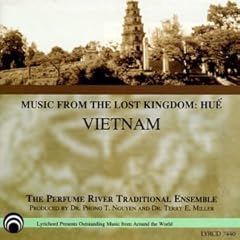
I first became interested in Vietnamese traditional music when I listened to the solo dan tranh works of ethnomusicologist and recording artist Dr. Phong Nguyen up on this website. I don't remember how I stumbled across that site, but those six songs really struck a chord in me, and for a long time I was on the lookout for any albums by the Perfume River Ensemble. Last month I found this one in the Asian section of Amoeba Music in Hollywood. The content is rather different from Nguyen's solo works I've come to love, likely because Nguyen himself doesn't actually play in this recording - he's credited as the Producer and Project Consultant. From the liner notes:
Vietnam's former imperial city, Hue, lies along the beautiful Perfume River near its entry into the sea in the country's central region, an area distinguished for its strong accent, tasty cuisine, and proud cultural heritage. From 1802 until 1945 a succession of thirteen emperors of the Nguyen Dynasty ruled the country from a fortress-like Forbidden City hidden within the walled Citadel, the latter period in cooperation with their French "protectors". The court at Huế was the last in a succession of Vietnamese dynasties which preserved the rituals and music that had existed at least since the founding of the Ly dynasty in the 11th century, whose court was located in Thang Long (now Ha Noi).
The emperors required dignified instrumental music for their rituals and audiences with foreign visitors. The court's power and splendor was demonstrated in its great orchestra (nha nhac), a chorus, and a dance company. Perhaps the most spectacular ritual was the Nam Giao (Heaven and Earth Sacrifice) first celebrated on a vast outdoor esplanade built by Emperor Ly Anh Tong (1138 - 1175). A similar esplanade was built slightly to the south of Hue in 1806 for the Nguyen emperors. The sacrifice took place annually in the spring between the hours of 2 a.m. and 5 a.m. In addition the court maintained three other ensembles: a dai nhac ensemble consisting of 20 larger drums, 8 double-reed shawms, 4 large gongs, 4 small gongs, 4 conch shell trumpets, and 4 water buffalo horns, all managed by a master conductor and 14 assistance conductors; a nhac huyen group mainly consisting of sets of stone chimes and bronze bells; and a tieu nhac sting ensemble which included a lead drum and several smaller percussion instruments playing interlocking patterns.
...
The present recording resulted from the first United States tour of a Vietnamese ensemble since the end of the war in 1975. The Perfume River Traditional Ensemble, directed by Mr. Vo Que, a poet and singer, is made up of authentic artists resident in Hue. Mr. Manh Cam, aged 78, is both a survivor from the original court ensemble [of Vietnam's last emperor, Bao Dai, who abdicated in 1945] and one of the country's Artists of Merit. The ensemble toured the eastern United States for two weeks during August, 1995, performing at Lowell Folk Festival, Masschusetts, New Haven, Connecticut, at the Smithsonian Institution in Washington, D.C., and at Lincoln Center in New York City. Their repertory includes music of the court, ca hue chamber music, and folk songs of central Vietnam, specifically the Thua Thien Hue and Quan Tri provinces.
The artists sing to the accompaniment of five traditional melodic instruments and numerous percussion instruments and drums. The former include the round-bodied long-necked lute, the dan nguyet long-necked flute, the dan tranh zither with 16 strings, the dan bau monochord, the two-stringed dan nhi fiddle, and the double-reed ken shawm. The percussion instruments include both clappers and pairs of teacups struck together.
The songs have a very ancient and otherworldly feel to them, and at times the singing can be rather abrasive on ears not fully accustomed to this culture, mine included. The ensemble's music is also rarely as downright beautiful as the Phong Nguyen solo recordings linked to above, but it is much more varied in character, possessing many exotic idiosyncracies. To point out just one, the final track, an improvisational duet between Tran Thao's nasal double-reed ken and the clacking percussion of master drummer Manh Cam, almost sounds like Interstellar Space in early Vietnam.
One of many composers who blurred the line between genius and lunacy, Alexander Scriabin created some of the most ambitious, complex, and downright orgasmic music of his time or any. The pieces on this recording, especially the Poem of Ecstasy and Prometheus (also called the Poem of Fire), surge and seethe with emotions both primal and highly refined. Scriabin (1872 - 1915) was a piano virtuoso, maverick composer, synaesthete (his perceptions of sounds and colors were intrinsically linked), and mystic. To get an idea of how mystical Scriabin could be, take for example that for the last dozen years of his life he toiled on a massive, multi-media project to be performed in the Himalayas, which Scriabin hoped would usher in the armaggedon and replace mankind with "nobler beings". The work, called Mysterium, would have been "a grandiose religious synthesis of all arts which would herald the birth of a new world" - unfortunately, it was never completed.
While the pieces on this album aren't quite as ambitious as that, they are nonetheless tremendous musical achievements, so grandiose and sensational as to make Wagner's most dramatic pieces seem docile by comparison. Pierre Boulez brings the Chicago Symphony Orchestra to seismic levels of intensity as they explore Scriabin's bizarre universe of exotic and ecstatic harmonies. According to Wikipedia, the Poem of Ecstasy combines two aesthetic principles Scriabin upheld: that music is the most highly evolved of the human arts, and that ecstasy is the most highly evolved of the human emotions. Novelist Henry Miller evidently thought very highly of the piece, writing
"That Poème de l'extase? Put it on loud. His music sounds like I think - sometimes. Has that far-off cosmic itch. Divinely fouled up. All fire and air. The first time I heard it I played it over and over. (...) It was like a bath of ice, cocaine and rainbows. For weeks I went about in a trance. Something had happened to me."
The Poem of Fire, if anything, is an even greater musical spectacle, calling for an enormous orchestra and vocal chorus, as well as a one-of-a-kind instrument called the clavier à lumières, a kind of organ/light-projector that would bathe the concert hall in color and sound. The music is somewhat more difficult than in the Poem of Ecstasy, making heavy use of Scriabin's dissonant "Prometheus chord" consisting of the pitches C, F♯, B♭, E, A, and D in various inversions. The climax of the piece sounds like a choir of angels singing the world to its end.
Sandwiched between those cataclysmic symphonic works is Scriabin's piano concerto in F# minor, an earlier work that displays the composer's love of Chopin. This is the most accessible piece on the album, lush, tender, delicate, and emotionally satisfying. It could be classified as post-Romantic, being strongly lyrical and expressive while exploring richer harmonies and more daring dissonances than was typical of the Romantic style. The first few achingly lovely minutes of the Andante movement sound like the work of a completely different composer than the Poems. However, the same movement features some very dark and abstract passages, and in general this concerto hints at the extremes Scriabin would take his music to in the last 15 years of his life.
Wikipedia reports that Scriabin was a life-long hypochondriac, and in 1915 he passed away from sepsis contracted from a shaving cut or lip boil.
Artists, send any requests for the removal of album download links to TheSoftWatch@gmail.com and I will do so immediately. Note that no albums are hosted on Giraffe Kingdom, and the links are only shortcuts that anybody could find elsewhere with a little work. We believe from the heart that online media sharing ultimately benefits artists.
 Here's an album I've been meaning to blog about for some time, Oorutaichi's Drifting My Folklore from 2007. I don't know much about Oorutaichi, other than that he's a Japanese solo artist/DJ who cooks up some seriously zany acid cartoon music. If you thought that was Cornelius's shtick, prepare to experience new levels of zany acidity - Drifting My Folklore comes bursting at the seams with mutated disco, freak funk, twisted pop hooks, synths and turntables galore, hypnotic grooves, and utterly bizarre vocal melodies that shouldn't work but somehow do. Rarely are albums simultaneously as strange and catchy as this one. Given the overwhelming number of different musical ideas that transpire throughout it, one must really admire Oorutaichi's flawless sense of craft in arranging so many instruments and studio effects into something cohesive, without a moment sounding out of place. (Then again, what could sound out of place on an album like this?) The studio tricks in particular are frequently mindbending and worthy of Nobukazu Takemura at his best. In the end there's probably no describing this album, so let's just say I can comfortably imagine alien robots doing their morning workout routine to it, and leave it at that.