An Evening With Dusty - Kyle Bobby Dunn from Joey Bania on Vimeo.
Friday, June 8, 2012

Wednesday, April 11, 2012
Fennel - Carillon Air
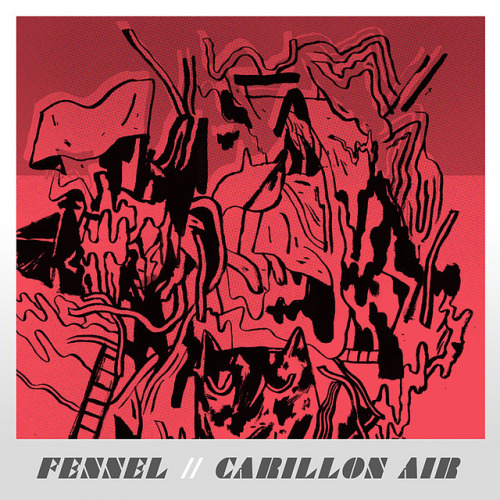
Carillon Air is the name of the new 13 minute Fennel piece available through bandcamp and, more excitingly, absence of wax. As this blog has become a de facto repository of Fennel recordings, I'm dropping it off here with one of my summaries. The core of the piece was assembled from field recordings made in Berkeley and Riverside, CA. Early in January I bought a melodica for playing when I couldn't get around to a piano. Not much of a substitute for a piano, but the thing has its charms, and it really got me thinking a lot more about (what else?) melodic concerns than I had been previously.
In Carillon Air the melodica, layered against itself, provides harmony in the first section, a kind of prelude. From then on it plays a strictly melodic role and there is no more overdubbing. The lines were culled from a lengthy improvisation session recorded in a garden one gray (but still very beautiful) morning.
This piece is my first conscious attempt to record something which could be taken for the audio track of a short film - not just the musical score, but also sound effects, dialog, natural ambiance and all. Though I was concerned with the music moving forward in a coherent way, I didn't really have an imaginary film running in my mind while making this, so the 'plot' is highly ambiguous - I focused on feeling and the interaction of dissimilar sounds (my basic working approach from the start of this project).
Downloadable through either link above. More music coming, always...
& thanks again, Devin Sarno!
Sunday, October 9, 2011
Fennel - Resuming the Trail
 Please enjoy the newest full-length Fennel album Resuming the Trail. Most of the work on this was done between early spring and late summer of this year, from the time I was anxiously waiting to see what would result of my school applications, up to just before I moved from Woodland Hills to Riverside. This is my most biographical and varied work yet, and the format this time around is quite different from before: there are 14 tracks adding to just over 35 minutes, and they're all seamless. No one track is fit to be isolated from the rest.
Field recordings were taken around Woodland Hills, Sherman Oaks, Santa Monica, Venice, Berkeley and Santa Barbara, California. These form a continuous environmental backdrop for the album, partly urban and partly natural, over which I put recordings of piano, guitar, voice, fujara (Slovakian overtone flute), and miscellaneous other sounds. My personal narrative unfolds in an exploded-fragmentary fashion, with much ambiguity. Some of the material was freely improvised and left unaltered; some of it was patched together from guided improvisations, and a little of it was completely premeditated and written out.
If you download this from Bandcamp ("name-your-price" as always), you'll get a couple bonus photos and a .pdf score for the piano part to one of the songs. You'll also get a good sized version of the swoon-worthy cover art made by Niv Bavarsky.
Huge thanks go out to everyone who has encouraged me or given advice or criticism of one kind or another. With the release of Resuming the Trail, I won't be producing new Fennel material for quite some time. Graduate study is quickly getting extremely time consuming. That said, I still think about music constantly and can guarantee the world will see more recordings come from me in the future.
Download for free or a donation
Friday, August 19, 2011
Focusbird EP
 One nice project I was involved with during my time at UCSB was a little band called Focusbird. We got our start playing house shows in Isla Vista with folk-oriented groups like the charming and talented Watercolor Paintings. Sarah Stanley wrote the songs, sang and played ukelele and flute, and I played glockenspiel and sometimes sang and helped with song arrangements. Our live shows, which culminated (to our amazement) in a memorable gig opening for Mirah in the spring of 2010, were always the quietest of the night.
This self-titled EP represents our six most frequently played songs - however, these recordings are more fleshed out in sound than what we used to perform live as a duo, thanks to the expert studio-direction of jazz pianist & composer Dory Bavarsky. His contributions, including parts for clarinet, harmonium and other instruments, constitute a sort of "orchestrated version" of Focusbird - though overall the sound is still very much stripped down. Let me thank Dory again here, as I can't do it enough for what a great job he did.
The cover art was made by the exceptionally talented illustrator Julia Kostreva. Her graceful vision of the music completed the package.
Focusbird is streaming at http://focusbird.bandcamp.com/; you can download the EP for free or for a donation. The band (in terms of its original performing lineup) is now on indefinite hiatus, as Sarah resides in New York and I remain in California; however, Sarah continues to write new songs and to practice mandolin, flute and singing. Follow her writings on science and music at http://seajellyexhibit.blogspot.com/.
Once more for those who skip to the bottom looking for links, download Focusbird at http://focusbird.bandcamp.com/.
Sunday, July 17, 2011
Granules - Unfolding
 Artwork by Sepehr Nabi
Granules is an experimental workshop - Sepehr, Niv and I have unique musical backgrounds, artistic interests and tastes, and we never once sat down to discuss specifically what our "sound" or aesthetic should be like, though we did discuss tracks in the works. The music developed naturally out of the constraints of our recording capabilities and what we were interested in playing and hearing. Many influences have made deep impressions on all three of us in different ways, including experimental electronic music, jazz, 20th century composition, ambient music, and even hip-hop. We want to abandon genre idioms and explore new expressions through experiments in texture, color and form. We also want to evoke unusual images. Unfolding began as somewhat of a jumble of ideas, but as we worked together for over a year, scrapping and revising tracks, a sense of movement and unification started to come together. I don't want to make any comment as to the emotional qualities of the music, save for that I've honestly never heard anything quite like it.
We present Unfolding on Bandcamp for download in most any file format, free of charge. Note that the album was designed as a continuous musical trip, and several of the track transitions are seamless, so make sure to hear it on a gapless playback device!
Stream and download Unfolding at:
http://granules.bandcamp.com
Thursday, June 2, 2011
Caesura
Hi there readers - allow me to formally announce that I won't be updating Giraffe Kingdom for an indefinitely long, possibly infinite time. But if you like my posts, don't fret, because I am merely moving locations and expanding my scope of writing content. Please stop by my new blog (about math, music and the visual arts), and follow me if you're on Tumblr!

Friday, March 25, 2011
Fennel - Relics

I'm very excited to finally give you all a new Fennel release. This 25 minute EP is called Relics because it deals with certain feelings and events that are now for the most part behind me. Work started on it shortly after the occurrence of my graduation from college last year, and continued on and off until the final touches were placed last February. All of the field recordings stem from in and around my home in Woodland Hills, CA.
"Deep Sky" was the very first thing I wrote after releasing A Leap Across A Chasm last June. The piece was inspired by walks around my neighborhood at certain times of day when the clouds and sunlight and trees all coalesce into something sublime. That kind of setting tends to fill me with a particular kind of cosmic longing or nostalgia that is hard for me to put into words. I would like to be forthcoming and acknowledge Brian Eno's "1/1" from Music for Airports as a major influence on the basic form of "Deep Sky"; from the first time I heard that magical track back in 2004, I had always wanted to attempt my own spin on the ambient piano-loop format. My loops (three main themes in different modes centered around the note D) were initially constructed from free improvisations, and then complicated by many dozens of small variations. I hoped to achieve a fractal-like effect, repetitive but ever-changing.
"Memorandum" has its roots in the early experiments that led to my debut full length. One weekend home from school, I was recording in my backyard when some negligence on my part led to an argument with my parents. Everything was caught on tape, but I didn't seriously consider using it for a piece until months later, when "Deep Sky" was nearly done. I ended up juxtaposing the fight with a much more serene memory of mine, that of a 100% ordinary afternoon spent working with my dad to repair a fence. Brought together, the two events give me a valuable, though incomplete, picture of my family dynamic. It is my hope that others will derive their own meaning.
Once again I have made my music downloadable for free at http://fennel.bandcamp.com. I sincerely appreciate all feedback and donations, two things that help ensure more releases in the future.
Best wishes to my readers and listeners!
Subscribe to:
Posts (Atom)