20. Freddie Gibbs - Str8 Killa
 Freddie Gibbs is a contender for the single most talented emcee on the rise today. He still hasn't released a proper debut studio album, but this nine-track EP, just shy of 40 minutes long, almost feels like one. Four elements come together to make Freddie Gibbs the most exciting young rapper: 1) he is technically a monster on the mic, effortlessly shifting his flow into any number of metric styles, sometimes at dizzying speed; 2) he only raps the truth; 3) the truth is that he hustled his way out of one of America's harshest ghettos, in Gary, Indiana, surrounded by poverty, violence and drugs; 4) he delivers his words over ace production. Str8 Killa is aptly titled - track after track kills. Overall the EP is an unapologetically heavy listen, with eight gut-punching descriptions of struggle, crime, abuse, death and most of all, force of will to survive in a harsh world, surrounding the center track "Personal OG", Str8 Killa's only respite to a kind of comfort, but still one tinged in darkness. Freddie Gibbs released this EP alongside a much longer mixtape titled Str8 Killa No Filla, ironically titled since it regretfully contains not just a little filler, mostly in the form of some weak guest performances and mediocre beats. But Str8 Killa is nothing but that. Don't miss this proper label debut of a rapper who will surely become known as one of the most vital alive.
19. Daedelus - Righteous Fists of Harmony
 In my estimation, this 26 minute EP is the best material Daedelus has released since the full length Daedelus Denies the Day's Demise in 2006. It is also his first release for Flying Lotus' Brainfeeder label, and arguably his most explorative and creative work to date. Behind the lush music is a complex unifying concept, the Boxer Rebellion of China at the turn of the 20th century. Now, I love a good concept album, but unfortunately what could have been a very interesting story is presented here in rather vague terms. In other words, this album earned this position on my list for its strictly musical merits. Nothing about this sounds Chinese or antiquated; other than from its name, song titles and certain lyrics, you would never guess this EP is about what Daedelus says it's about. But that's alright; Righteous Fists of Harmony features heart-swellingly lovely songs. The most accessible is "Order of the Golden Dawn", featuring Daedelus' wife Laura Darlington on vocals. The tune sounds like a lost bossa nova classic worthy of the great Nara Leão. Why we get bossa nova in the middle of a trip to rebellious China ca. 1900, I do not know, but it sure is a wonderful track. Other standouts are the short instrumental "Tidal Waves Uprising" with its multitude of acoustic guitar loops building up and threatening to spill over; the mysterious and nostalgic "The Open Hand Avows" with high lilting synth melodies and hypnotic arpeggios; "Succumbing To" with gorgeously sighed vocals from Kid A and fully acoustic instrumentation including strings and a bass clarinet; and the dreamy closing track "Fin de siècle" which sounds like it could have been composed by Maurice Ravel, a complement of the highest order. A couple other tracks are more aggressive and evoke the violence of the Boxer Rebellion; the most surprising of these is "The Finishing of a Thing", the early climax of the EP and the most programmatic (as in illustrative) track, in which a hesitant fanfare is overwhelmed by an avalanche of war drums and noise. The following three mellow tracks are denouement after that explosion of sound, and it's an interesting puzzle to imagine what they all have to do with the overarching concept. If the overall relation of the Boxer Rebellion to this music is a little hazy, at least that allows for a variety of possible interpretations for the listener. Daedelus deserves much applause for this artful release that owes as much to acoustic as electronic music.
18. Onra - Long Distance
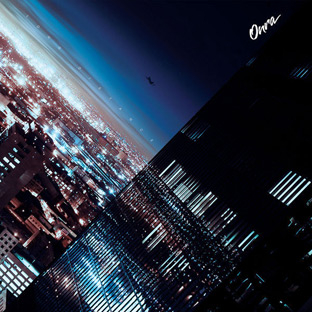 Like the currently in theaters "True Grit" by Joel and Ethan Coen, Onra's Long Distance is a lovingly-made genre work. The French beatmaker aimed to put a fresh spin on funk, boogie, and R&B from the 80s and 90s, revitalizing these styles with the luxurious production of contemporary hip hop. The result was a smashing success, and one of my top summer jams of 2010. The dominant mood throughout is blissful nostalgia, all neon glo-lights, disco balls and slap bass. If that makes it seem like the album rides on its oldschool appeal, that isn't really the case; the songs are deep and detailed enough to warrant many listens. Not a fully instrumental affair, a lot of strength is lent to Long Distance from several vocals performances spread across the album, like the irresistibly catchy "High Hopes" featuring Reggie B., and "The One" featuring T3 of Slum Village. As great as the few vocal-heavy tracks are, three consecutive instrumental tracks around the middle of the album got stuck in my head for the longest: "Send Me Your Love", a deeply beautiful shimmering funk ballad; "We Out Buddy", an uber-groovin synth romp that somehow makes me think about Ghostbusters; and "Moving", a perfectly hazy throwback to G-Funk with some downright dangerous bass. My only complaint is that Long Distance is a bit long for what it is; a few lesser tracks could have been cut from the second half without any damage done to the album. Quibble aside, Onra has certainly proved himself a capable and versatile musician - who could have predicted the switch to this style after his great chronicle of Chinese and Vietnamese pop & hip hop, Chinoiseries?
17. A.G. - Everything's Berri
 "Song for song, hook for hook, verse for verse / Line for line, or word for word, or letter for letter / I'm A.G.!" Wordsmithing on that level or better pervades Everything's Berri, my favorite rap album of 2010. A.G. or André the Giant has been active for two decades now, seizing credibility early on as a member of the legendary Diggin' In The Crates crew. "Twenty years in, so my pen is worth more than your necklace." A.G.'s attitude on Everything's Berri is generally laid back and cool but not comfortable. Many of the tracks sound mellow, even pretty, but A.G. isn't just kicking back on his laurels: "Put our life where our mouth is (Money ain't enough) / Death before dishonor (You die if you bluff)." Plenty of grit and dark self-reflection comes into the picture throughout the album, like on the fierce "Destroy Rebuild Repeat": "To reach my level you have to fall / Then rebuild, and repeat / Times that times four / Lose your peeps, lose your whore, lose your freedom, lose it all / Then get it back / And after that if you didn't crack / Then we'll consider that. / To be here is a miracle / But it's a phenomenon to be this lyrical / Now sit with that." Production-wise the album mostly favors stripped down and jazzy instrumentation, with piano, Rhodes, horns, and exceptionally good flute work. The best tracks sound like classic 90s joints, full of soul, and only one of them sticks out in a weird way, namely "No She Didn't", the closest the album comes to being club-friendly. I can easily imagine Akon doing something over the beat to "No She Didn't" - not a good thing. A.G.'s rapping on this sketchy track is pretty goofy as well, but fortunately it is immediately countered by the dope "Fuck The Club". The rest of the album is remarkably consistent, even if a few of the tracks represent more mainstream themes like pretty girls and/or chilling out; the production and lyrical craft is solidly creative 'til the very end. On the haunting closer "YMI Still Here", A.G. questions how he has outlived so many of his peers and friends, mourning the loss of 2Pac, Biggie, Big L and a host of others. We are lucky to still have this veteran around - André the Giant is an authentic force for the old school yet one of the freshest emcees active today.
16. Erykah Badu - New Amerykah Part II: Return Of The Ankh
 I'm a little embarrassed to admit Return Of The Ankh was the first album I heard by Erykah Badu. Given how high profile the singer is, I'm sure I've been hearing her songs on the radio for years, but I somehow never realized Badu is much more than a radio-single type of artist, that in fact she's arguably the most important contemporary soul singer. Given what a major success this album was, I doubt I will be able to say anything about it that hasn't been already said a hundred other places. So let me simply say that it's an outstanding assortment of R&B/soul/hip-hop/funk without a single dud, with production from the likes of 9th Wonder, Madlib, and J Dilla, among others, and with Badu's trademark jazzy improvised vocal flourishes. The album doesn't feel particularly weighty in concept or message, but it can be put on at any given track and instantly appreciated. From start to finish Return Of The Ankh never wavers from a position perfectly in between sophistication and direct enjoyability.