Showing posts with label orchestral works. Show all posts

Thursday, January 14, 2010

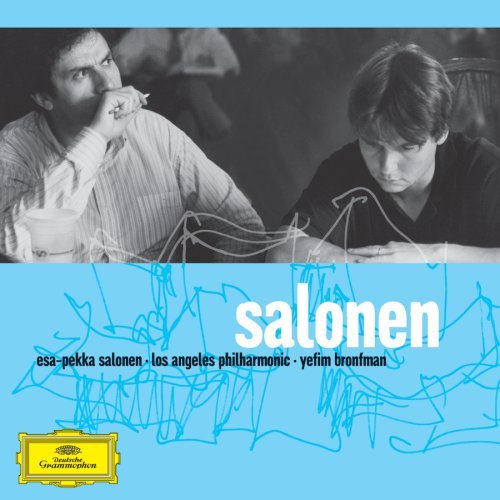
Esa-Pekka Salonen - Helix, Piano Concerto, & Dichotomie

"I think of myself basically as a composer," Esa-Pekka Salonen has often been heard to say, "with a little conducting on the side to help pay the bills." Despite the charming modesty of these words, the more remarkable fact is the actual phenomenon of Salonen today - not merely another of those composers who can manage a little conducting if called upon, not merely a conductor with a couple of symphonies in a secret portfolio, but a master at the top of both professions. Here, on this disc, is further proof. (Alan Rich)
Taken from the liner notes to the album, this excerpt nicely summarizes the man who has been the most important champion for new music in Los Angeles for the last 25 years. Under his lead the L.A. Phil has performed world premieres of works by Arvo Pärt, John Adams, John Corigliano, and many others, as well as important pieces by Ligeti, Stravinsky, Bartok, and scores of other adventurous composers. As of the time of writing, Salonen is on hiatus from conducting to spend more time composing, a move that, despite his great talent for conducting, shouldn't make anybody unhappy, because his music is terrific.

This album has recordings of three recent works, Helix (2005) for orchestra, a three-movement piano concerto (2007), and Dichotomie (2000) for solo piano. The recording of the piano concerto, with pianist Yefim Bronfman, is of the piece's world premier performance. The first two pieces are both extremely lively and full of color, utilizing every resource of the orchestra to consistently creative and emotive results. Helix follows a predetermined and mathematically informed structure, that of a spiral wrapping around a cone. The piece, working in a mood reminiscent of certain bits from Stravinsky's La Sacre du Printemps, steadily builds in tempo and dynamics for nine minutes until it reaches its climactic breaking point - the tip of the cone. Salonen's first piano concerto, on the other hand, has a much more organic (and hence difficult to describe) form. As the liner notes put it,
"The music gathers strength as piano and orchestra engage in a variation of the opening slow music. Low woodwinds carry on in an interlude, 'the elegance of very large animals' (Salonen). The variety of orchestral events is breathtaking; a duet for piano and viola, a fast orchestra answer to that duet, a grand romantic sweep accompanied by arpeggios in the strings. Then comes a new sound: a solo saxophone in a haunting, slow melody, a reminder that one of Salonen's great early works was a concerto for that instrument. It is joined now by the piano and by the strange, otherworldly whistle of three piccolos. The first movement ends."
The second two movements, equally epic and adventurous, bring the concerto to a hefty 33 minutes in length. This is one to sit down and listen to when you know you have the time to appreciate it.

The final piece on the album is Dichotomie for solo piano, a piece with a somewhat minimalist/austere character but packing a lot of ferocity. Divided into two sections, Mecanisme and Organisme, the work is almost 20 minutes of constantly streaming notes whose intensity rises and falls in slow waves, demanding amazing virtuosity from Yefim Bronfman.

In 2009 Salonen completed a violin concerto, and he plans to soon return to conduct the L.A. Philharmonic during part of its 2010-11 season.* Very good news for lovers of contemporary concert music in L.A.

Download
Purchase
*http://www.laphil.com/press/press-release/index.cfm?id=2390

Friday, August 21, 2009

Alexander Scriabin - The Poem of Ecstasy, Piano Concerto in F# minor, Prometheus


One of many composers who blurred the line between genius and lunacy, Alexander Scriabin created some of the most ambitious, complex, and downright orgasmic music of his time or any. The pieces on this recording, especially the Poem of Ecstasy and Prometheus (also called the Poem of Fire), surge and seethe with emotions both primal and highly refined. Scriabin (1872 - 1915) was a piano virtuoso, maverick composer, synaesthete (his perceptions of sounds and colors were intrinsically linked), and mystic. To get an idea of how mystical Scriabin could be, take for example that for the last dozen years of his life he toiled on a massive, multi-media project to be performed in the Himalayas, which Scriabin hoped would usher in the armaggedon and replace mankind with "nobler beings". The work, called Mysterium, would have been "a grandiose religious synthesis of all arts which would herald the birth of a new world" - unfortunately, it was never completed.

While the pieces on this album aren't quite as ambitious as that, they are nonetheless tremendous musical achievements, so grandiose and sensational as to make Wagner's most dramatic pieces seem docile by comparison. Pierre Boulez brings the Chicago Symphony Orchestra to seismic levels of intensity as they explore Scriabin's bizarre universe of exotic and ecstatic harmonies. According to Wikipedia, the Poem of Ecstasy combines two aesthetic principles Scriabin upheld: that music is the most highly evolved of the human arts, and that ecstasy is the most highly evolved of the human emotions. Novelist Henry Miller evidently thought very highly of the piece, writing
"That Poème de l'extase? Put it on loud. His music sounds like I think - sometimes. Has that far-off cosmic itch. Divinely fouled up. All fire and air. The first time I heard it I played it over and over. (...) It was like a bath of ice, cocaine and rainbows. For weeks I went about in a trance. Something had happened to me."
The Poem of Fire, if anything, is an even greater musical spectacle, calling for an enormous orchestra and vocal chorus, as well as a one-of-a-kind instrument called the clavier à lumières, a kind of organ/light-projector that would bathe the concert hall in color and sound. The music is somewhat more difficult than in the Poem of Ecstasy, making heavy use of Scriabin's dissonant "Prometheus chord" consisting of the pitches C, F, B, E, A, and D in various inversions. The climax of the piece sounds like a choir of angels singing the world to its end.

Sandwiched between those cataclysmic symphonic works is Scriabin's piano concerto in F# minor, an earlier work that displays the composer's love of Chopin. This is the most accessible piece on the album, lush, tender, delicate, and emotionally satisfying. It could be classified as post-Romantic, being strongly lyrical and expressive while exploring richer harmonies and more daring dissonances than was typical of the Romantic style. The first few achingly lovely minutes of the Andante movement sound like the work of a completely different composer than the Poems. However, the same movement features some very dark and abstract passages, and in general this concerto hints at the extremes Scriabin would take his music to in the last 15 years of his life.

Wikipedia reports that Scriabin was a life-long hypochondriac, and in 1915 he passed away from sepsis contracted from a shaving cut or lip boil.

Download
Buy

Sunday, November 23, 2008

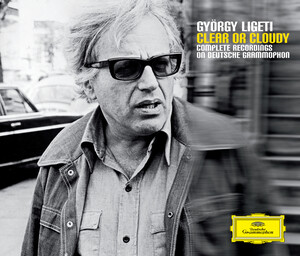
György Ligeti - Clear or Cloudy [Box Set]

In tribute to the great Hungarian iconoclast who passed away in 2006, Deutsche Grammophon released this affordable collection of his works spanning the 1960s to 1990s. The selections are varied, covering the many facets of Ligeti's personality and invention in a wide range of formats.

Disk 1:
Sonata for Solo Cello
Bagatelles for Wind Quintet
String Quartet No.1
Ten Pieces for Wind Quintet
String Quartet No.2

Disk 2:
Atmospheres
Volumina
Lux Aeterna
Organ Study No.1: Harmonies
Lontano
Ramification
Melodien

Disk 3:
Aventures for 3 singers and 7 instrumentalists
Nouvelles Aventures
Concerto for Violincello and Orchestra
Chamber Concerto
Mysteries of the Macabre
Double Concerto for Flute and Oboe

Disk 4:
The Big Turtle Fanfare from The South China Sea
3 Pieces for 2 Pianos
Etude for Piano, Book 1, No.2
Etude for Piano, Book 1, No.4
Concerto for Piano and Orchestra
Concerto for Violin and Orchestra

A great deal could be said about all of these works and the composer in general, but suffice to say he was one of the most influential and creative figures of late 20th century music; though his imaginative process was frequently confounding, his music still displays a sense of playful joy.

Download Disk 1
Download Disk 2
Download Disk 3
Download Disk 4
Own it New for 22.43!

Sunday, October 5, 2008

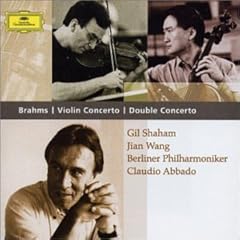
Gil Shaham & The Berlin Philharmoniker play Brahms


This acclaimed Deutsche Grammophon recording features two ecstatic works by Brahms, the Violin Concerto in D, and the "Double" Concerto for Violin & Cello in A-minor. Both pieces are staples of late-Romanticism, replete with lush orchestration, advanced harmonies, and explosive emotion. Gil Shaham is a virtuoso with a satisfying balance of delicacy and fervence, and the engineers of Deutsche Grammophon have, as many of us have come to expect of them, achieved an excellent sonic reproduction of a very rich orchestral texture.

Download
Buy Used and New from $5.74

Sunday, August 24, 2008

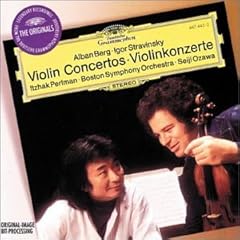
Itzhak Perlman & The Boston Symphony Orchestra w/ Seiji Ozawa - Violin Concertos


This Grammy winning recording of three complex, expressive works by three composers as different from each other as they were individually brilliant, was recorded in 1980 yet is still an essential reference for these pieces more than 25 years later. On the program:

1-2. Alban Berg's Violin Concerto "Dem Andenken eines Engels" ("To the Memory of an Angel")
The duration is 25'49. This was Berg's last completed piece before his death; the composition is rooted in 12-tone theory, but with an atypical amount of free artistic creation afforded, so that it often sounds tonal or beautiful. In this author's opinion the piece would serve as an excellent introduction to the territory covered by Schoenberg, Webern, Berg, and others, mainly because it is so exciting and lush, with a great deal of memorable melodic content. Even Bach makes a cameo during the close of the second movement.

3-6. Igor Stravinsky's Violin Concerto in D
The piece opens with a dramatic chord flair before quickly developing a theme a little bit reminiscent of Christmastime. And as this is Stravinsky, the whole affair is marked by relentless creativity, wit, and a very wide range of expression. Lasting 21'39 and spanning four movements, at times exuberant and at times heartbreaking, the listener will be finding new nuances in this composition for years.

7. Maurice Ravel's "Tzigane"
Technically not a violin concerto, at 9'31 this piece opens with four minutes of harrowing solo violin figures before some spooky new colors from the New York Philharmonic begin to enter. But while deceptively small in scale in the first half, this piece features a great deal of contrast, and before long a large number of variations in texture, rhythm, pace, and timbre occur with increasing urgency. Perlman really displays ferocity on this one, and each peak of energy from the whole orchestra is breathtaking.

Perlman and Ozawa have proved to make an excellent team, the former's great virtuosity and emotional impact matching beautifully with the latter's great instincts in timing, dynamics, and overall understanding of the music. The content of this recording proves that the tradition of 20th century composition is about much more than intellectual prowess and artistic austerity - it celebrates the human spirit in an unprecedented way.

Download
54 Used & New from $3.89