Monday, December 8, 2008

Nobukazu Takemura - Scope

This 1999 album marked Japanese DJ savant Nobukazu Takemura's debut into highly experimental, difficult to classify music, which had previously been primarily club oriented or at least closer to the traditional side of IDM. "On A Balloon" kicks things off ambitiously with more than 20 minutes of utterly alien, amorphous sounds, whose original sources we can only guess at. His process for generating these sonic wonders involves sending some of the outputs of his mixing board back into the inputs, creating a feedback loop with many exotic possibilities. The palette of sounds constantly changes, but many melodic and textural themes do recur - Takemura's use of building up and breaking down patterns keeps the careful listener in constant attention and surprise. His use of stereo panning is also very impressive here; headphones are recommended to appreciate all the detail present.

Next is "Kepler", the most accessible song on the album and arguably the highlight. It finds Takemura in a minimalistic setting reminiscent of Steve Reich's most textural pieces, with beautiful warm synthesized melodic figures repeating in a meter that one would rather just cruise with than hope to count. Soon micro-aural vocal samples enter, unpredictably fracturing and interacting until they form steady rhythms. All the while the underlying harmony undergoes sudden modulations, drastically changing the mood from serene to ominous and back. This song is a gem among the best electronic creations this author has heard.

The remaining material maintains a high standard, though much of it is a good deal less accessible. On "Taw", many jarring, dissonant, awkward, and confusing sounds are juxtaposed in complicated ways that many listeners may not find musical in any traditional sense. This is not music to tap one's foot to. Nevertheless, Takemura's imagination is always at full force, and even the most bizarre moments have a sense of humorous invention to them. There is also beauty to be found all the way through, especially on "Icefall", in which a fuzzy opening melody is joined by bubbling bleeps and bloops to create a joyous, frenetic texture of bouncing notes. Closing the album is "Tiddler", a sluggish, good natured piece with the feel of a hymn or lullaby.

Download
Purchase

Saturday, December 6, 2008

Paco de Lucia - Cositas Buenas


I am ashamed to say that for most of my life I'd written off Paco De Lucia as a latin-jazz-fusion cheeseball. I'm not sure why exactly I made that judgment, considering I'd hardly heard any of his music, aside from one album by The Guitar Trio with Al Dimeola and John McLaughlin, which honestly, I don't rememeber. I think it may have been an opinion transferred to me by my older brother, who was a big influence on my music tastes for a long time. Anyways - when that brother handed me this album "Cositas Buenas" I was stunned. I had for some reason come to associate De Lucia with empty technical wankery and fusion corniness, but I was hearing something completely fresh to me - modernist flamenco! Off-kilter rhythms, unworldy vocals, beautiful melodic narratives carefully dancing around eachother - complex, but not in a way that places too much emphasis on Paco's virtuosity (of which there is plenty, wow) - but complex in all the right ways, to deepen and enrich the music. Perhaps nicest of all is that it's rare to find music this rich in intellectual musical fervor that is so plainly danceable - each song on this album is based on the rhythms of a traditional Flamenco dance form, but Paco explores every option that rhythm seems to allow - skirting around and in-between that rhythm to the point where it's barely recognizable. Perhaps I'm unusual in this regard, but my absolute favorite thing for music to be is surprising - this album consistently surprises. Beautiful, fun, and definitely surprising.

Here's a more sensible, to the point review:
For four decades, Spanish guitarist Paco de Lucia's jazzy, Mephisto-like technique redefined flamenco. This CD, which means "Good Small Things," is de Lucia’s first release in five years, and it's been worth the wait. Most of the eight tracks feature just de Lucia, a chorus of vocalists, percussion, and the zesty handclaps called palmas. Lucia and company take you through the Moorish, Jewish, and Gypsy inventions and dimensions of flamenco, from the buleria "Patio Custodio" and the torrid tientos "El Tesorillo" to the moody, mid-tempo buleria por soleatres, foreshadows the future of this ancient and inventive art form. --Eugene Holley, Jr.

Try
Buy

Sunday, November 23, 2008

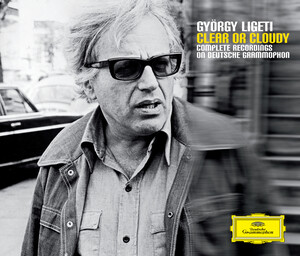
György Ligeti - Clear or Cloudy [Box Set]

In tribute to the great Hungarian iconoclast who passed away in 2006, Deutsche Grammophon released this affordable collection of his works spanning the 1960s to 1990s. The selections are varied, covering the many facets of Ligeti's personality and invention in a wide range of formats.

Disk 1:
Sonata for Solo Cello
Bagatelles for Wind Quintet
String Quartet No.1
Ten Pieces for Wind Quintet
String Quartet No.2

Disk 2:
Atmospheres
Volumina
Lux Aeterna
Organ Study No.1: Harmonies
Lontano
Ramification
Melodien

Disk 3:
Aventures for 3 singers and 7 instrumentalists
Nouvelles Aventures
Concerto for Violincello and Orchestra
Chamber Concerto
Mysteries of the Macabre
Double Concerto for Flute and Oboe

Disk 4:
The Big Turtle Fanfare from The South China Sea
3 Pieces for 2 Pianos
Etude for Piano, Book 1, No.2
Etude for Piano, Book 1, No.4
Concerto for Piano and Orchestra
Concerto for Violin and Orchestra

A great deal could be said about all of these works and the composer in general, but suffice to say he was one of the most influential and creative figures of late 20th century music; though his imaginative process was frequently confounding, his music still displays a sense of playful joy.

Download Disk 1
Download Disk 2
Download Disk 3
Download Disk 4
Own it New for 22.43!

Thursday, November 20, 2008

Tim Hecker - Haunt Me, Haunt Me Do It Again


Tim Hecker is one of Canada's foremost experimental ambient artists, and many of the track titles on this seamless album reflect the cold atmosphere of his country. Names like "Music for Tundra", "Arctic Loner's Rock", and "Boreal Kiss" evoke strong images, and the music itself does the same; it would be a fitting soundtrack for a desolate expanse of ice or slowly flowing glacier. The songs are constructed mainly from purely digital means, with beautiful shimmering drones, crackles, pops, hisses, creaks, clicks, and synthesized melodies. Occasionally we also hear recognizable instruments and vocal samples, which make the album more emotionally accessible. Most of the material has a melancholic and nostalgic feel to it, perfect to accompany oneself during a solitary night under a sky full of stars.

Download
Purchase starting from $10.55

Friday, November 14, 2008

Keith Jarrett - The Carnegie Hall Concert


This concert was recorded in late 2005, but only released nearly a year later as a double album. It depicts Jarrett in top form, engaging in the purely improvised odysseys that made him famous. Fans of The Koln Concert, La Scala, and the Vienna Concert have surprises in store regarding the format of this solo date; for after returning to live performance after years of battle with chronic fatigue syndrome, Jarrett found he no longer had the stamina required for 40+ minute sojourns into the limits of his and the piano's capabilities. Now he conducts his improvisations as a series of shorts ranging from 3 to 10 minutes, where each vignette is directly influenced by the one preceding it (the opening improvisation is very abstract indeed). Much of the music here is dense and challenging, but it is also endlessly rewarding, as repeated listens reveal great depth and deliberation in his stream-of-conscious playing. After 10 of these miniature marvels, Jarrett closes the set with a superb encore of 5 standards, including his own compositions "Paint My Heart Red" and "My Song". Another fantastic look at arguably the greatest living genius of jazz piano.

Download Part 1
Download Part 2
Purchase New for $15.49

Monday, November 3, 2008

Shuttle 358 - Optimal.LP

I can hardly describe this album better than was done by AmbiEntrance back on July 25, 1999:

optimal.lp draws heavily from the microscopic and ostensibly souless world of digital electrons, giving them loose structure, warmth and life by way of stunningly arranged sound patterns. In this most impressive debut, shuttle358 (a.k.a. Dan Abrams) has constructed a definitive ambient/electronic blend. For further insights, see this month's interview with Taylor Deupree of 12k.

Generating its own bio-mechanical atmosphere, a hazy, rhythmic echosystem opens swarm, to be joined by thinly hovering rays, muted notes and occasional insectoid electronic accompaniment. Sweeping over bug-like sound patterns and a bed of static, slowly in... casually drones in a straight line, with further accents from smooth bell-tones. Airy synthflow adorned by a faint shuffle, and slightly disruptive microbursts is next (1:49).

Echoing with self-replicating patterns and just a bit of grit, gone goes peacefully amidst a radiant electron mist, overlain with synth strata. A thin, computerized techno-tribal beat penetrates the free-floating dronecloud of optimal, which simply basks in its lovely radiation field. A distorted voice twice questions the listener of floops which proceeds to sing a story of abstract electronics which pulse, drone, warble and waft oh-so-beautifully.

Beginning as an evolving sonic protoplasm, emergent eventually spawns small beats which rise from its densely simmering miasma. A cyclic techno-mechanical backdrop is draped with lushly swelling synth sheets in system (8:35), which receives additional visitations from electrically warbling fly-bys, muffled notes and precise, tinny syncopation. From a random gel, tank grows into something a bit more active, as its dully chiming notes begin to cascade and multiply in a gorgeously geometric soundsculpture; eventually the form suffers entropy, fading away and falling apart, though achingly lovely all the while.

Operating as shuttle358, Dan Abrams proves that the "cold" mechanics of computerized sound can be given distinct warmth and beauty. optimal.lp absolutely radiates with a dazzling blend of precision and passion, evoking a hearty 9.4. Seriously, you'd best be getting over to the 12k website and getting your copy of this masterpiece; it's limited to 500 copies...
...and those 500 copies have long been sold. Today the album is only available for download.

Sunday, November 2, 2008

Alog - Duck-Rabbit


"Norwegian duo Alog's second CD is "As Complicated and as Beautiful as Always," to quote one of the track titles. The rich constructions of samples and real instruments, both reassembled on the computer after the initial improvisations, continue to challenge the mind, but this time around the duo has shifted its focus. While 1999's Red Shift Swing showed a strange but definite filiation with jazz (both free and lounge, go figure), Duck-Rabbit is an ersatz distillation of pop and techno. The album title itself illustrates the kind of Frankenstein-inspired surgery that Espen Sommer Eide and Dag-Are Haugen accomplish. The important thing is that the resulting creature lives. The danger was to fall into a recipe, something Alog cleverly avoided by varying its inspirations and sources. The music itself sounds just a bit less convincing, or maybe it is only because it requires a little more effort from the listener. Highlights include "Violence and Magical Danger" (nice voice samples providing a chilling effect), the title track, and "Idea-Changing Liquid Alchemy," the latter being one of the group's easiest tracks but also a very successful one. The closing "Drunk DJs" represents the biggest surprise: an acoustic guitar duet, the antithesis of everything that came before. What's even more surprising is that one can only agree this was the best way to end Duck-Rabbit. " - Francois Couture, AMG

Download