Saturday, September 13, 2008

Boris Malkovsky - Time Petah-Tiqva

Full of fire, restless energy, ominous darkness, and delightfully spooky pizzicato, this avant-garde release on John Zorn's Radical Jewish series mixes "Jewish traditions with classical, gypsy and downtown improvisation" (Tzadik). Sounds fairly esoteric, but the atmosphere of the record is usually anything but - this is fun, accessible music packed with real emotions and astonishing group coherence through a lot of highly complex pieces. For the inclined the word "math" might come to mind while listening to this, but the constantly changing, bouncing rhythms really feel closer to ethnic traditions from Eastern Europe than the contemporary math rock scene, and never feel like the point of the compositions. Led by Malkovksy's button accordian and held together by the Israel Contemporary String Quartet (plus an extra contrabassist), this is 50 minutes of delight.

Download
Tzadik Records page
Own it for $7

Avishai Cohen Trio - Gently Disturbed


Avishai Cohen plays a unique breed of jazz informed by the traditions of his native country, Israel. On this album he plays with drummer Marc Giuliana, who is astounding, especially live, and with a new pianist, the 20 year old Shai Maestro. I personally feel Avishai's albums don't approach his live show, which really is fantastic, but this album comes closer than he has in a while.

Download
Buy from Avishai

Monday, September 1, 2008

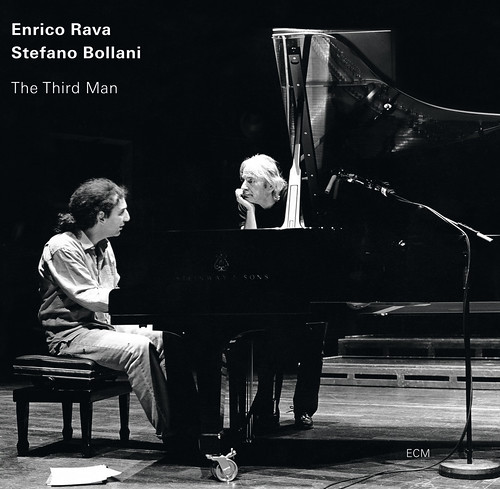
Enrico Rava/Stefano Bollani - "The Third Man"


From AMG:

While
The Third Man is a skeletal, live-in-the-studio duo recording between pianist Stefano Bollanni and Italian treasure, trumpeter Enrico Rava, its sound moves far beyond the intimacy that such a pairing would normally warrant. Bollani and Rava have been playing together for over a decade, and these 12 pieces reflect the deep communication that exists as a result of that working relationship. According to Bollani, they have worked as a duo in concert settings before and on record, but never like this. What this means is that both the recording studio -- the Auditorio Radio Svizzera in Lugano, Italy, and Manfred Eicher's recording process for ECM that allows recording without headphones in direct communication -- played a unique and powerful role, as well as an informative one in the process of making the record. The title of the disc references Eicher as a collaborator, as well as referring good-naturedly to Orson Welles and the film noir tradition. Rava composed six of the album's tracks, Bollani one, and the pair freely improvised the hauntingly beautiful and melodically compelling title cut. There are all sorts of nods here. For openers, there's Bruno Martino's "Estate," a Neapolitan folk song, which was extrapolated upon by Antonio Carlos Jobim for "Retrato Em Branco y Preto." The original plus two versions of the Jobim tune are here. This track and its evolution marks passage through the set at beginning, middle, and the final variant, right near the end. Then there is the magnificently tender reading of "Felipe," by one of Brazil's greatest composers, Moacir Santos. (Check out his Blue Note sides, which are available as inexpensive imports from Europe at good online retailers.) Its open, reverie-like character is brought into the present by Rava's deeply expressive take on the melody, as Bollani offers augmented chords that enhance and deepen it. When he takes his solo, he uses the melody as a way inside the character of the tune, making it a bittersweet cavern of memory. "Cumpari," by Rava, is a fine and strangely complex lyrical approach to modern composition. The contrapuntal pianism of Bollani as he uses three different scalar approaches to the motifs in the structure nod to everyone from Stravinsky, Bartok, and even Lutoslawski, but they echo Bernard Hermann, Umiliani and Morricone, as well. Rava engages a more dimensional and textural approach in his solo, where he adds vanguard and modal jazz to the mix. This is the only "remotely" outside thing here. At just under five minutes, it is still a delight, and melds well with the more deeply and consciously melodic pieces here. It's a wonder that "The Third Man" is so near the beginning, because it is arguably the best thing here. That said, it doesn't detract from the rest as much as it provides an aural view into the deeply conversational and historically rich sound world being so poetically explored between this pair. While it's also true that it is indeed the Italians who have put such a lyrical, emotionally honest stamp on jazz since the '60s and are indeed involved in a tremendous period of creativity with it since the '70s that shows no sign of slowing down (no matter which subgenre of the music being made), these two are among its most expressive and communicative, making them ambassadors. The Third Man is a brilliant collaboration and a beautifully accessible as well as adventurous offering.

Try it
Buy from Amazon.com

Wednesday, August 27, 2008

Waldemar Bastos - Pretaluz

Pretaluz or "black light" is a fitting title for an album with such stark contrasts. Angolan songwriter and musician Waldemar Bastos sings of much joy and pain over nine beautiful songs, which contain elements of Afropop and tropicalia, frequently making strong use of guitar and rhythm. However, Bastos' voice is the highlight of the album - it ranges from warm and friendly to horrifically despairing, and gives all of the music a sense of emotional sincerity that distinguishes it from more typical worldbeat albums. Angolan pride is infused throughout the work, motivating a combination of African tradition with modern pop elements derived from many regions of the world. Finally it is worth noting while it's still August that "Rainha Ginga" makes for one of the greatest sun-tinged summer songs this author has yet heard.

Download
Used from $1.67 / New from $7.00

Tuesday, August 26, 2008

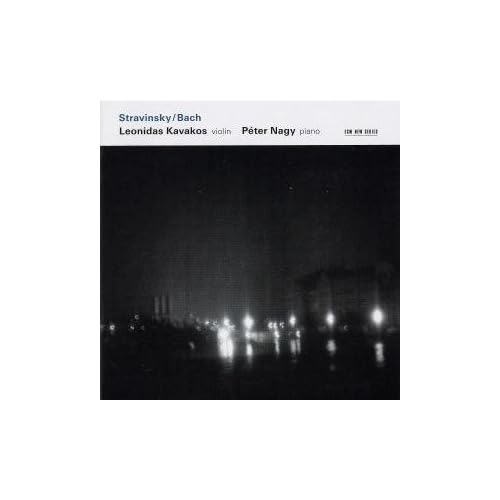
Leonidas Kavakos, Peter Nagy - Stravinsky/Bach

This is a wonderful album. Alternating between pieces by Igor Stravinsky and Johannes Sebastian Bach, Leonidas Kavakos and Peter Nagy dance and gasp through moments of baroque rationality, aggressive modernism, and achingly beautiful serenity. The combination of Stravinsky and Bach works quite well and the playing is masterful. The highlight here is the first piece, (and the least accessible), Stravinsky's relatively unheard of "Duo Concertante", but all the selections are gorgeous. Leonidas Kavakos' violin is the star of the show here - he plays with an expressive fervor, and his gasps for air add some humanity and struggle to his otherwise seemingly effortless playing.


Download
Buy

Sunday, August 24, 2008

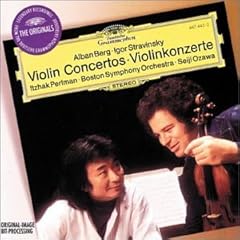
Itzhak Perlman & The Boston Symphony Orchestra w/ Seiji Ozawa - Violin Concertos


This Grammy winning recording of three complex, expressive works by three composers as different from each other as they were individually brilliant, was recorded in 1980 yet is still an essential reference for these pieces more than 25 years later. On the program:

1-2. Alban Berg's Violin Concerto "Dem Andenken eines Engels" ("To the Memory of an Angel")
The duration is 25'49. This was Berg's last completed piece before his death; the composition is rooted in 12-tone theory, but with an atypical amount of free artistic creation afforded, so that it often sounds tonal or beautiful. In this author's opinion the piece would serve as an excellent introduction to the territory covered by Schoenberg, Webern, Berg, and others, mainly because it is so exciting and lush, with a great deal of memorable melodic content. Even Bach makes a cameo during the close of the second movement.

3-6. Igor Stravinsky's Violin Concerto in D
The piece opens with a dramatic chord flair before quickly developing a theme a little bit reminiscent of Christmastime. And as this is Stravinsky, the whole affair is marked by relentless creativity, wit, and a very wide range of expression. Lasting 21'39 and spanning four movements, at times exuberant and at times heartbreaking, the listener will be finding new nuances in this composition for years.

7. Maurice Ravel's "Tzigane"
Technically not a violin concerto, at 9'31 this piece opens with four minutes of harrowing solo violin figures before some spooky new colors from the New York Philharmonic begin to enter. But while deceptively small in scale in the first half, this piece features a great deal of contrast, and before long a large number of variations in texture, rhythm, pace, and timbre occur with increasing urgency. Perlman really displays ferocity on this one, and each peak of energy from the whole orchestra is breathtaking.

Perlman and Ozawa have proved to make an excellent team, the former's great virtuosity and emotional impact matching beautifully with the latter's great instincts in timing, dynamics, and overall understanding of the music. The content of this recording proves that the tradition of 20th century composition is about much more than intellectual prowess and artistic austerity - it celebrates the human spirit in an unprecedented way.

Download
54 Used & New from $3.89

Saturday, August 23, 2008

John Schneider - Lou Harrison: Por Gitaro

This is an album entirely of solo acoustic guitar playing, with light percussion added on select tracks. Listeners may be skeptical they possess the attention span to sit through over an hour of such a bare overall texture, but novelties abound for the uninitiated into the colorful world of microtonal music.

Briefly, the story is this: ancient Greek scholars beginning with Pythagoras held with certainty that perfect music note intervals should be constructed from simple, whole-number ratios, such as 1:1, 2:1, 3:2, etc. These ratios respectively correspond with the perfect unison, octave, and fifth. However, seemingly irreconcilable problems arise when one tries to invent a complete tuning system with these simple ratios, for the numbers refuse to add up and at least one bad-sounding interval becomes inevitable.

The modern solution to this was a compromise: it was agreed upon that the octave should be split into 12 notes, each an equal distance apart in terms of ratios. Equal temperament tuning, then, is based upon the 12th root of 2 - an irrational number. While the irrational frequencies of equal temperament tuning are quite close to their perfect rational counterparts, this compromise means only the unison and the octave sound as good (in terms of purely physical consonance and dissonance) as what is theoretically possible. On the other hand, it is a practical solution: every interval does sound acceptably good for most people.

But not for all, and thus is motivated the need for microtonal composition, which eschews equal temperament and the very heart of Western music - the 12 notes per octave. Indeed, in non-Western spheres many cultures adopt altogether different tuning systems, such as Turkey with a 53 note per octave system. The compositional possibilities of these expanded pitch palettes fascinated many 20th century Western composers, including Lou Harrison, whose compositions are featured on the 2008 recording Por Gitaro.

Most of these pieces therefore feature themes which sound exotic or ethnic to Western ears, and all feature those golden, pure ratios lost to the system of equal temperament. John Schneider's playing is well-paced, precise, and not in the least lacking in emotion, ranging from somber and reverent ("Threnody to the Memory of Oliver Daniel") to whimsically playful ("Tandy's Tango"). This will appeal to audiophiles, guitarists, mystics, and any lover of beauty.

Download
Mode Records page