It's high time Giraffe Kingdom goes live again. Axolotl is the free-form sound project of experimental violinist/vocalist Karl Bauer, as well as his collaborators William Sabiston and Brian Tester. Memory Theatre, released in 2007, is a compilation of several of their hard-to-find releases, with quite a wide variety of atmospheres and moods. But if you haven't heard those releases, Memory Theatre will sound more like a unified album than a compilation, so it's the perfect introduction to the band. The music is extremely lush and evocative, bringing to my mind things like swarms of particles in Brownian motion, the frenzied yet precise movements of an ant colony, the boiling innards of a star, or a malfunctioning Tesla coil. Each piece is a wall of unfamiliar sounds, teeming with controlled chaos, never quite settling on any single idea, always subtlely evolving. At the same time there is a certain amount of stasis to each piece, in that a given song rarely strays particularly far from the texture it establishes at its beginning.
Aesthetically the pieces gracefully blend mechanical/technological sounds with those of a more organic/biological nature. For example, "Anamalon" bubbles with electric energy and prickly static over unsteady, wooden sounding thuds. This is followed by the gorgeous "Natura Naturans", which sounds like a field recording from some kind of magical forest with will-o'-the-wisps hanging in the air. Farfetched, perhaps, but this kind of music lends itself to such extravagant visual interpretations. Axolotl have put together a refreshing collection of sonic organisms, and aside from the last track (11 truly challenging minutes of noise) it is quite accessible, at least when approached with an open mind.
Most Westerners familiar with Tan Dun, China's most prominent composer, know him through his Academy Award winning score for "Crouching Tiger, Hidden Dragon", or through his works commissioned for the 2008 Beijing Olympics. Fewer are likely to have heard his more personal and artistically adventurous works, which bridge Eastern and Western traditions while exploring a musical language of Tan Dun's very own. One of the most fascinating of these is Ghost Opera, which puts a (post)modernist spin on an ancient and somewhat polarizing genre - the Chinese opera.
Commissioned in 1994 for the Kronos Quartet and pipa player Wu Man, the five movement Ghost Opera is fairly short (35 minutes) but packed with challenging material that will defy any listener's expectations. Opening the first movement is the sound of water splashing in a great glass bowl, followed by a beautiful and haunting quotation of Bach's C# minor prelude from The Well-Tempered Clavier, Book 2. Just as we're beginning to get comfortable, a shrill note in the upper register of the violin rudely interrupts the serene Bach, and the chilling voice of a monk spirit enters the act. Things move quickly now from strange to bizarre, as a variety of male and female spirit-voices shout wordless incantations over abstract and menacing string gestures. The second movement begins as a high energy dance, with driving string parts and more shouting from the spirits, but in the end winds up showcasing Wu Man's virtuosic pipa skills over a bare texture. The third movement, lacking vocalizations, blends the Bach heard previously with a Chinese folk song, "Little Cabbage", to gorgeous effect. Its sheer melodic accessibility is countered by the next movement, which is almost totally rhythmic, featuring unsteady percussion on a variety of stones and metallic cymbals, and later, percussive string strumming. As the piece mounts in intensity, the spirits return with more excited clammoring than ever, and ultimately a gong hit marks the beginning of the final movement, the most understated and "ghostly" one of them all.
"My whole village was crazy. We had a professional crying team available for hire at funerals and deaths...a shamanistic choir to set the mournful tone. In Hunan, where I grew up, people believed they would be rewarded after death for their sufferings. Death was the "white happiness," and musical rituals launched the spirit into the territory of the new life. Instruments were improvised: pots and pans, kitchen tools, and bells. The celebration of the remote was grounded in everyday life.
The tradition of the "ghost opera" is thousands of years old. The performer of "ghost opera" has a dialogue with his past and future life — a dialogue between past and future, spirit and nature."
As stated before, Chinese opera is a polarizing genre. Many people find it difficult to appreciate, and attendence to live performances has been on the decline since the second half of the 20th century (see the Wikipedia entry on Beijing Opera). Ghost Opera, aside from being a rumination on modern spirituality, is an attempt to rejuvenate this unusual and uniquely beautiful art form.
Released last February, this ECM recording from the somewhat veiled yet influential trumpet player Jon Hassell is his first for the label in more than 20 years. In the meantime he released a number of albums for other labels, steadily giving more and more definition to the style of music he describes as "Fourth World". He coined this term as early as 1980 (hear Fourth World: Possible Musics with Brian Eno from that year) to refer to music which combines jazz improvisation, futuristic electronics, atmospheric ambience, and ethnic influences.
Fans of the Norwegian free improvisation troup Supersilent will immediately draw comparisons between Hassell's airy, floating trumpet tone and that of Arve Henriksen. Besides having both recorded for ECM, and sharing a delicateness of tone and penchant for thoughtful improvisation, the two are linked further by mutual involvement with Jan Bang, who controls the electronic samples on this album. However, the atmosphere of Last Night The Moon Came... is distinct from anything Arve Henriksen has had a hand in. The opening track "Aurora", a wash of electronic textures over a minimal bass ostinato, with almost no melody, sounds closer to releases on 12k Records or Hearts in Space than any I've heard on ECM or Rune Grammofon. It's a beautiful commencement to the album, and one that gives the listener no sense at all of how many musicians are involved. Besides Hassell and Bang, we have Rick Cox and Eivind Aarset on guitars, Peter Freeman on bass and a laptop, Jamie Muhoberac on keyboards and a laptop, Kheir Eddine M Kachiche on violin, and drummers Helge Andreas Norbakken and Pete Lockett.
Despite the size of the lineup and richness of instrumentation, the music throughout this album is almost always highly subdued and sparse in texture. There are no crescendoes or sudden changes in direction anywhere, there are no choruses, the songs plod along at a mostly uniform tempo (very slow), and most of the melodic content is fairly unmemorable. These statements are not meant to detract from the quality of the album, however; only to demonstrate that it is far from a typical ECM release, and instead lives in a world of Hassell's own, dominated by meanderings through quasicomposed mires of sound. At times, like on the very short but supremely effective interlude "Clairvoyance", the result is devastatingly beautiful. On the other hand, another even shorter interlude, "Scintilla", features a lovely violin gesture but isn't given the opportunity to do much else, and its inclusion almost feels superfluous. For different reasons, one wishes both of these tracks were more fleshed out.
The meat of the album is found in the longer tracks, two of which go past the ten minute mark. The Fender Rhodes in "Abu Gil" makes the track reminiscent ofMiles Davis' In A Silent Way, but with a stronger Indian influence and much more ambience. The outstanding title track is halfway between a moody Steve Roach drone and an organic chamber improv, with Hassell's overdubbed trumpet producing warm harmonies over the most minimal of beats, joined by violin flourishes and low-key electronic sound effects.
If there are any serious criticisms to make about this album, it's only that the last quarter of it begins to feel redundant. No individual track is weak in terms of musicianship, but the listener paying close attention may tire of the overall sound and mood of the album, which is for the most part dreary and listless, before it's finished. This could have been remedied by replacing the last tracks with some more dynamic and explorative ones, but that would have taken away from the purity of the whole. For providing a unique aura anywhere it's played, the album is perfect as it is. Jon Hassell's "Fourth World" vision, refined over decades, has culminated in a remarkable release, and what he does next is anybody's guess, though it's sure to be of interest.
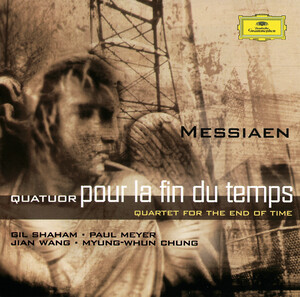
One of the most proclaimed chamber works of the last century, it is widely known that Olivier Messiaen's "Quartet for the End of Time" (for violin, clarinet, cello, and piano) was conceived and composed within the Nazi prison camp Stalag VIII A. Given this, and the fact that Messiaen was already at the forefront of musical exploration before his wartime captivity, one could reasonably presume the Quartet is heavy, discordant, and menacing. This is indeed the case at times, but it's impossible to summarize the whole piece so quickly and easily - Messiaen's fascination with bird songs, modal melodies, supernatural or "heavenly" harmonies, rhythmic augmentation and diminution, eternity, infinity, and Catholic mysticism is in full effect throughout the composition.
Particularly striking to the author is the third movement, for clarinet alone, which lasts nearly 9 minutes and features incredibly elegant and lyrical phrasing, achieving as much expression with elongated notes as with empty rests. Etienne Pasquier, cellist among the original four performers of the Quartet, sheds light on the history of this movement in an interview reproduced in the liner notes:
Among our comrades was a clarinettist who was a member of the Orchestre National and who had been allowed to keep his clarinet. Messiaen started to write a piece for him while we were still in this field [where prisoners were held] as he was the only person there with an instrument. None of us had a violin or a cello or a piano. And so Messiaen wrote a piece for clarinet that was later to become the third movement of the Quatuor pour la fin du temps: Abîme des oiseaux (Abyss of the birds). Henri Akoka, the clarinettist, practised in the open field and I acted as his music stand. The piece seemed to him to be too difficult from a technical point of view and he complained about it to Messiaen. "You'll manage," was Messiaen's only reply.
The same interview contains many other fascinating anecdotes, including that the camp directors at Stalag VIII A constituted the front row of the audience at the very successful premier performance, and that Messiaen and his fellow performers were given preferential treatment as "musician soldiers" and released four years before the rest of the prisoners.
Other highlights include the fiery, rhythmically complex sixth movement ("Dance of frenzy for the seven trumpets") and the heartbreaking eighth and final movement ("Eulogy to the Immortality of Jesus"), which according to Messiaen represents "the ascent of man towards his God, of the Child of God towards his Father, of the deified Being towards Paradise."
Each player on this recording is somewhat of a celebrity in the world of concert music, and followers of Giraffe Kingdom will already have a recording featuring Gil Shaham and Jian Wang paired together, namely on Brahms' "Double Concerto". Paul Meyer on the clarinet is as comfortable playing works by modernists like Penderecki and Berio as by giants of the Classical and Romantic eras. Rounding out the group, pianist Myung-Whun Chung is, like Shaham, a Deutsche Grammophon exclusive artist; no stranger to Messiaen's orchestral oevre, he is present on recordings of the TurangalîlaSymphony, Éclairs sur l'au-delà (Illuminations on the Beyond), L'Ascension, and much more. This is his first recording of chamber work.
"This quartet is in eight movements. Why? Seven is the perfect number, the six days of Creation, sanctified by the Divine Sabbath; the seven of this rest is prolonged into eternity and becomes the eight of everlasting light, of eternal piece." - Olivier Messiaen
Fans of the melodic shoegaze stylings of Asobi Seksu will find much to enjoy about the three songs on this short EP by the Ecstasy of Saint Theresa, a Czech group formed in 1990. The band's first releases, the Pigment e.p. (1991) and debut album Susurrate (1992), feature distorted guitar textures very prominently, and are heavily indebted to My Bloody Valentine. By 1993, the Ecstasy of Saint Theresa were experimenting with elements of electronic and ambient music, and ...fluidtrance centauri... finds the band honing a more unique sound. "Fluidum" opens gently with light chimes and graceful delayed guitar chords, but the chorus lets loose with some heavy distortion and beautiful wah guitar treatment. "Alpha Centauri" and "Trance (Between The Stars)" follow this dynamic approach, both featuring a lot of contrast between pretty, mellow sections and energetic rock-outs. The band has had a steady stream of releases since their formation, the most recent being Watching Black (2006). Sample it on their MySpace.
Shangri-La does exist, but it's about 2,500 miles east of the Himalayas, in of all places, Taiwan. In the year 2000, accomplished cellist David Darling visited the Bunun people, "a tribe of Taiwanese aborigines...best known for their sophisticated polyphonic vocal music" (Wikipedia). The result was an album so exquisitely beautiful it simply must be heard to be believed.
At the forefront of Mudanin Kata (Journey Home) is the joyful communal singing of the men, women, and children of the Wulu Bunun. Beneath their gorgeous indigenous harmonies, David Darling provides just the right amount of accompaniment, generally remaining delicate and understated, never competitive. Sometimes he plays as little as a single bowed note, or nothing at all; elsewhere he multitracks his playing, creating a chamber orchestra effect that splendidly complements the gladsome voices. He lays down some bluesy pizzicato on "Malas Tapag" (Celebration), and in the call-and-response singing one can actually hear the smiles on the faces of the Bunun.
Then there's "Pasibutbut" (Prayer For A Rich Millet Harvest), a harrowing hymn for 8 male voices which harmonically blend in ways that were unknown to the Western world until 1943, when a Japanese scholar brought a recording of the piece to Paris, causing quite a sensation. According to the album's liner notes, "‘Pasibutbut’, which has been called the ‘sound of nature’, is said to have been created by a member of the Bunun who was inspired by the sound of humming bees, a rushing waterfall or the sounds made when crossing through a pine or bamboo forest".
On "Wulu Dream", "Wulu Mist", and "Wulu Sky", Darling takes some solo time, but half of the effectiveness of these interludes stems from the lush ambience of the thriving jungle they were recorded in, thick with the chatter of local birds and frogs. One really feels transported to another place. While David Darling is guilty of having produced some fairly drab new age music, this album is anything but, and he should be applauded for bringing the Bunun to a wider audience.
Fans of Nobukazu Takemura will potentially like this album by No. 9 - Mushi No-Ne combines ambient/jazzy-techno/computery noise into a nice, laidback album. Standout track is "Bug Beats" - great melody.
Artists, send any requests for the removal of album download links to TheSoftWatch@gmail.com and I will do so immediately. Note that no albums are hosted on Giraffe Kingdom, and the links are only shortcuts that anybody could find elsewhere with a little work. We believe from the heart that online media sharing ultimately benefits artists.